
Public Scholarship: How to Sell a Gendered Fantasy

I’m thrilled to share How to Sell a Gendered Fantasy, a collaboratively authored volume that emerged from my Spring 2025 graduate seminar, WRT 614: Intersectionality and Media. The volume, which would make a great textbook for an upper-level undergraduate or entry-level graduate course on media, criticism, or intersectionality, is freely available in the Stony Brook Academic Commons.

WRT614 was taught in my final semester at Stony Brook University’s Program in Writing and Rhetoric (I’ve since moved to the new Department of Communication). Rather than ask students to write standalone papers, I tasked students with working collectively to develop a shared theme, peer review submissions and revise extensively, and shape this book as a cohesive collection of critical media analysis. The result is a volume that interrogates how media sells gendered fantasies — not just products or platforms, but ideals, anxieties, and power structures — through an intersectional lens.

The 13 essays range in topic from digital trends like Tradwife influencers to entertainment media like Glee and The Bachelor; from K-pop music videos to video games like Resident Evil 2. I plan to use this volume in my COM346: Race, Class, and Gender in Media course this fall, and I hope many of you educators, researchers, and anyone interested in media and identity studies will find it insightful and helpful as well.
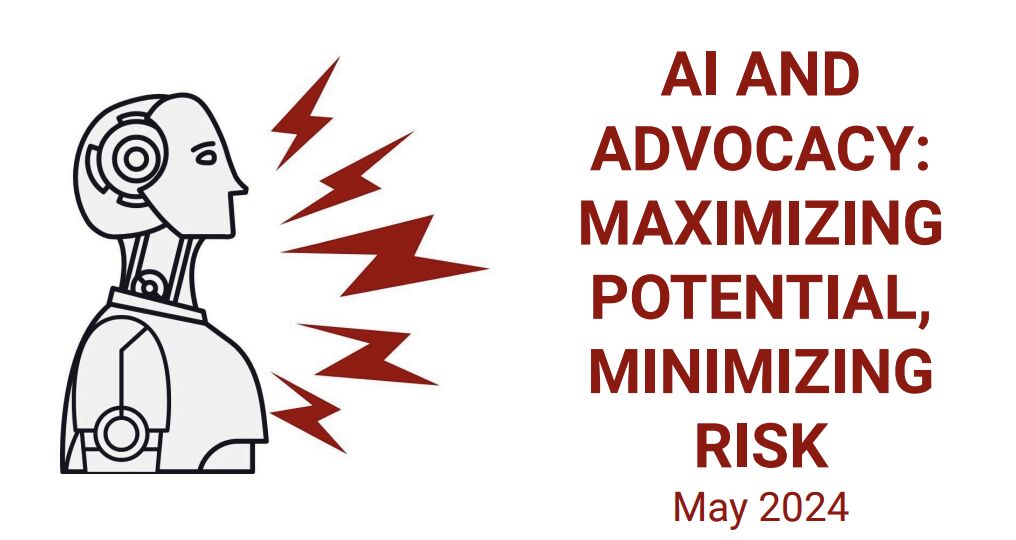
Public Scholarship: AI and Advocacy: Maximizing Potential, Minimizing Risk

Last week I, along with students in my “AI and Advocacy” course at Stony Brook University, released a new report entitled “AI and Advocacy: Maximizing Potential, Minimizing Risk.” The report addresses any advocate who is considering using AI in their work. We argue that AI can be useful for advocates, but they must be careful to center human judgment and avoid risks that could distract from their important work or even contribute to societal harms. You can download and read the whole report on the Stony Brook Academic Commons.

The report identifies three major opportunities and accompanying risks, plus one strong recommendation:

  1. Advocates can use AI tools to increase outreach—at the risk of compromising trust
  2. Advocates can use AI to address complex issues—at the risk of partially hindering progress
  3. Advocates can use training data to advocate for their causes—at the risk of misinformation and bias
  4. Advocates must be proactive to assess privacy impacts before deploying AI tools

Below, I’ll expand on a few of these insights, plus talk a bit about the pedagogy of collaborative report-writing. I previously shared these on my LinkedIn page. Please share and help us reach folks interested in the intersection of AI and Advocacy!

Continue reading “Public Scholarship: AI and Advocacy: Maximizing Potential, Minimizing Risk”

Public Scholarship: Preparing Communication Studies for Artificial Intelligence

I wrote “Bring on the Bots? Public Scholarship: Preparing Communication Studies for Artificial Intelligence” as the lead feature for the May-June 2023 issue of Spectra, the National Communication Association’s online magazine.

In 1966, Joseph Weizenbaum, then a professor at the Massachusetts Institute of Technology (MIT), published a paper that introduced his chatbot ELIZA, a computer program that made “certain kinds of natural language conversation between man [sic] and computer possible.” In the paper, he writes about a chatbot, a program that allows a human user to have a seemingly natural conversation with a computer program. Weizenbaum’s ELIZA chatbot imitates a Rogerian psychotherapist who puts the burden of the conversation primarily on the client by prompting them to share more and expand on their experience, as shown above. ELIZA is considered one of the first chatbots ever made, and its convincing dialogue sparked the term “ELIZA Effect” to describe how users anthropomorphize conversational machines.  

Like Weizenbaum, I have created a bot. Mine, @RhetoricTweeter, is a Twitter bot that produces a hypothetical thesis for rhetorical criticism once per day, e.g., “In my next paper, I will use decolonial theory to uncover that Gay Instagram Memes cultivated the critic. #TeamRhetoric.” Created in my first year of graduate school, I was experimenting with a more productive use of automation than popular examples of election-meddling and anti-vaccine bots. @RhetoricTweeter joined a legion of “good bots”—like Protest Bots and Art Bots—on Twitter that have since been largely killed off under Elon Musk’s ownership.  

After creating @RhetoricTweeter, I hosted a “Deliberative Bots” workshop in 2019 during a department colloquium at the University of Maryland, College Park. My colleagues and I created and published our own Twitter bot, and I attempted to demonstrate why experimenting with bots and automation—when there were plenty of humans to engage with!—might be worth their time. In the last nine months or so, those of us who are studying artificial intelligence (AI) and communication have rarely needed to explain the relevance of our research. That’s because one chatbot has fundamentally reshaped our cultural conversations: ChatGPT.  

You can read more on NCA’s Spectra.

Public Scholarship: Research profile on ARHU blog

The University of Maryland’s College of Arts and Humanities recently featured me on their Voices from the Field blog that highlights research from ARHU graduate students.

As his interest in a career in local journalism declined, he found rhetorical studies in a slightly different hallway of the communication department. Matthew knew he was hooked when he started taking courses on media and cultural criticism, social movements, and argumentation, because they linked his interest in media, publics, activism, and education. He ended up at UMD after his undergraduate mentors introduced him to the work of his now-adviser, Dr. Damien Pfister. He thought: “I can do that for the next 5-6 years? Great. Sign me up.” 

Now, as a Rhetoric and Political Culture Ph.D. Student in the Department of Communication, Matthew is researching digital media, social change, and affect. Rhetoric is, by Cicero’s definition, an ancient art of invention, arrangement, style, memory, and delivery. Matthew is primarily concerned with invention. He wants to explore how digital media could be (and are being) used to invent more equitable, just worlds.

You can read the full profile on the Voices from the Field blog. Thanks to Fatima Montero for interviewing me and Fielding Montgomery for passing on my research to ARHU.

Public scholarship: “Women who ran for Congress avoided women’s issues in their campaign ads”

Authored by Shawn Parry-Giles, Aya H. Farhat, Matthew Salzano, and Skye de Saint Felix for The Conversation.

The journalistic story we wrote stems from research we did, along with other researchers, for the Political Action Research Center at the University of Maryland’s Rosenker Center for Political Communication. View the full-length research paper here.

Below is an excerpt from The Conversation; you can read the full journalistic summary of our report that we wrote on their website.

A record number of women were sworn into Congress on Jan. 3.

The influx of women candidates helped turn the midterm election into what many observers dubbed a “Year of the Woman.”

But despite a tide of voter sentiment favoring women, these winners got to Congress or a statehouse not by defining themselves as “women’s candidates,” but instead by sidestepping issues typically associated with their gender, from equal pay to reproductive freedom.

We are experts on women and politics, and in a recent study we conducted at the University of Maryland’s Rosenker Center for Political Communication & Civic Leadership, we examined 2018 political ads to understand how woman defined their candidacies and qualifications for office.

We found that, despite the momentum of the #MeToo movement, women were careful in playing the “gender card.” They avoided what are often construed as “women’s issues” that are associated with gender equality such as abortion, pay equity, sexual violence and harassment.

Public scholarship: interview on Philosophy Bakes Bread podcast

Philosophy as Play — Ep. 64 of Philosophy Bakes Bread

After presenting our paper at the Public Philosophy Network conference, Eric Thomas Weber (co-host of PBB) asked Sergia Hay, Mike Rings, and me to talk about our paper for their podcast. The show airs in Lexington, Kentucky, and is available online. You can read more about the episode and listen on SOPHIA’s (the Society for Philosophers in America, which sponsored the panel and sponsors the podcast) website.